
A pencil breaks.
Someone takes the blue block.
A child doesn’t get to be first in line.
A game doesn’t go the way someone expected.
And suddenly, everything feels very, very wrong.
There are tears. Someone shouts. A chair scrapes across the floor. One child is experiencing one very big feeling while the rest of the classroom keeps moving.
Teachers see moments like these every day.
Children experience frustration, disappointment, anger, excitement, worry, jealousy, and conflict as they learn to navigate a busy classroom. Helping them manage these emotions is an important part of emotional regulation in the classroom.
But emotional regulation isn’t about teaching children to stop having big feelings.
It’s about helping them understand those feelings and learn what they can do when those feelings arrive.
Children gradually develop emotional regulation through experience, language, modelling, routines, and repeated opportunities to practise.
One simple framework can help:
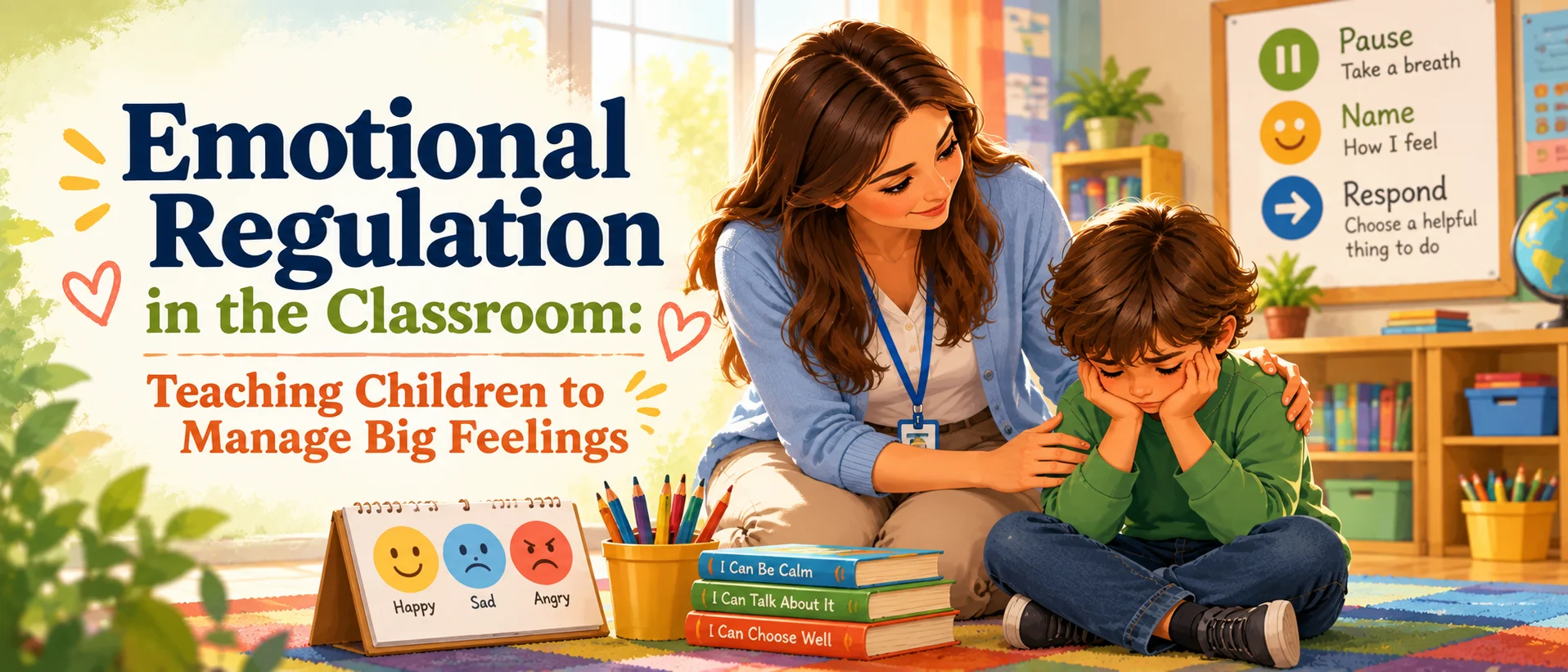
PAUSE → NAME → RESPOND
First, create enough space to stop the immediate reaction.
Then help the child recognize what they’re feeling.
Finally, help them choose what to do with that feeling.
The goal isn’t to eliminate big emotions.
The goal is to help children learn how to respond to them.
Understanding Emotional Regulation in the Classroom
A child’s behavior is often the first thing adults notice.
A child pushes another child away from the blocks.
We see:
Pushing.
A child tears up their work.
We see:
Destructive behavior.
A child refuses to join an activity.
We see:
Noncompliance.
These behaviors still need appropriate boundaries.
But behavior may not tell us everything that is happening underneath.
A child may be experiencing:
- Frustration
- Embarrassment
- Disappointment
- Fear
- Overwhelm
- Confusion
- Jealousy
- Tiredness
- Difficulty communicating
Understanding the feeling does not mean accepting inappropriate behavior.
We can hold both ideas at once:
“You’re allowed to be angry.”
and:
“You’re not allowed to hit.”
This distinction is an important part of teaching children emotional regulation.
Children need to understand that feelings are acceptable, while some behaviors are not.
Teach Emotional Skills Before Difficult Moments
The middle of a meltdown is rarely the best time to introduce a completely new emotional-regulation strategy.
Teach these skills when children are calm.
Use:
- Storytime
- Circle time
- Role-play
- Games
- Class discussions
- Everyday conversations
Ask questions such as:
“What does angry look like?”
“What might your body feel like when you’re worried?”
“What could you do when you’re frustrated?”
When children practise these skills before a difficult situation occurs, they have something familiar to draw on when emotions become stronger.
We’re not trying to invent the fire drill while the building is on fire.
We practise first.
Help Children Build a Feelings Vocabulary
Children can’t always explain exactly what they’re experiencing.
A child may not be able to say:
“I’m frustrated because I was expecting the activity to continue and I’m finding the transition difficult.”
They may simply shout:
“NO!”
Young children need words for what they’re experiencing.
Start with familiar emotions:
- Happy
- Sad
- Angry
- Scared
Then gradually introduce more specific words:
- Frustrated
- Worried
- Disappointed
- Excited
- Nervous
- Embarrassed
- Lonely
- Jealous
- Proud
- Confused
- Calm
The more accurately children can describe what they’re feeling, the easier it becomes to talk about what might help.
Instead of:
“I feel bad.”
A child may eventually be able to say:
“I’m disappointed because I didn’t get a turn.”
That’s significant progress.
Giving children emotional vocabulary gives them another way to communicate what is happening before the feeling turns into a behavior.
Teach Children to Notice What Their Bodies Are Saying
Feelings aren’t only words.
Children can also learn to notice physical signals in their bodies.
Ask:
“What happens to your body when you’re angry?”
They might notice:
- My fists get tight.
- My face feels hot.
- My heart beats fast.
- I want to shout.
What about nervousness?
- My tummy feels funny.
- I don’t want to talk.
- I want to stay near the teacher.
What about excitement?
- I want to move.
- I talk quickly.
- I can’t wait.
These physical clues can help children notice an emotion before it becomes overwhelming.
Eventually, a child may begin to recognize:
“My body feels like this when I’m getting angry.”
That recognition creates an opportunity to pause.
Teach the Pause
The pause doesn’t have to be complicated.
For younger children, it might simply mean:
Stop.
Hands to yourself.
Take a slow breath.
Children can practise simple strategies such as:
- Smelling an imaginary flower and slowly blowing out a candle
- Counting slowly
- Taking a drink of water
- Sitting somewhere quiet
- Putting their hands together
- Asking an adult for help
The aim isn’t to force the emotion away.
It’s to create a small space between:
Feeling
and:
Action.
That space is where better choices can begin.
Name the Feeling
Once the immediate situation is safer, help the child put words to what happened.
Try:
“You look really frustrated.”
Or:
“I wonder if you’re disappointed because you wanted another turn.”
Notice the language.
“I wonder…”
rather than:
“You ARE…”
We can offer emotional vocabulary without insisting that we know exactly what the child feels.
The child may correct you.
“I’m not sad! I’m MAD!”
Good.
They’ve named it.
And naming the feeling can be an important step toward understanding what happens next.
Separate Feelings From Behavior
This is one of the most important messages we can give children:
All feelings are allowed.
Not all behaviors are allowed.
A child can be furious.
They still cannot hit.
A child can be disappointed.
They still cannot destroy another child’s work.
A child can be jealous.
They still cannot take something from someone else.
Try:
“It’s okay to be angry. It’s not okay to hit.”
Then add:
“What can we do instead?”
Now you’re not punishing the emotion.
You’re teaching a different response.
This is a central part of emotional regulation in the classroom: children learn that they can experience strong emotions while still making safe and respectful choices.
Give Children Positive Replacement Behaviors
Simply telling children what not to do leaves a gap.
“Don’t shout.”
Okay.
What should I do?
“Don’t grab.”
Then how do I get a turn?
“Don’t hit.”
What do I do with all this anger?
Children need replacement behaviors they can actually use.
Instead of grabbing, teach:
“Can I have a turn when you’re finished?”
Instead of hitting, children can:
- Step away
- Use words
- Ask for help
- Squeeze their hands together
- Take a pause
Instead of shouting across the room, they can:
- Move closer
- Raise a hand
- Use an agreed classroom signal
Behavior support becomes much more useful when children know what to do instead.
Use Stories to Explore Feelings and Emotions
Stories give teachers a wonderful opportunity to discuss emotions when nobody in the classroom is currently upset.
A character loses something.
Pause.
“How do you think they feel?”
Someone makes an unkind choice.
“Why do you think they did that?”
A character is left out.
“What could someone do to help?”
A character makes a mistake.
“What should happen next?”
Children can explore emotional situations through fictional characters without feeling that the conversation is directly about their own behavior.
Character-based stories can provide natural starting points for discussions about:
- Choices
- Consequences
- Friendship
- Empathy
- Patience
- Disappointment
- Courage
- Problem-solving
The character has the problem.
The children help solve it.
Later, when something similar happens in the classroom, the story can become a shared reference point.
Ask What Happened Before Asking “Who Started It?”
Two crying children arrive.
The immediate question might be:
“Who started it?”
Now you’ve created a courtroom.
Both children begin proving why the other person is responsible.
Instead, once everyone is calm enough to talk, try:
“Tell me what happened.”
Listen to one child.
Then the other.
You may discover:
One child thought the game was finished.
The other didn’t.
One thought the block was available.
The other was saving it.
One thought something was funny.
The other thought they were being laughed at.
Understanding what happened doesn’t mean nobody is responsible for their behavior.
It simply helps you teach from the actual problem.
Don’t Force an Immediate Apology
Two children argue.
You separate them.
Then comes:
“Say sorry.”
“Sorry.”
Problem solved?
Not necessarily.
An apology can be meaningful.
But a forced word said while a child is still furious may not teach much.
Instead, first help children understand:
What happened?
How did the other person feel?
What needs to happen now?
The appropriate response might be:
- An apology
- Helping rebuild something
- Returning an item
- Giving someone space
- Trying again
- Making a different choice
Repair matters more than simply producing the word sorry.
Create a Calm Space, Not a Punishment Corner
A classroom calm area can be useful.
But children quickly understand the meaning adults attach to spaces.
If the calm corner becomes:
“The place naughty children are sent,”
children may resist using it voluntarily.
Instead, present it as a place anyone can use when they need a moment.
It might contain:
- A comfortable cushion
- Feelings visuals
- A simple breathing prompt
- A sensory object
- Paper and pencils
- A timer, when appropriate
The purpose isn’t:
“Go away until you’re good.”
It’s:
“Here’s somewhere you can regain enough control to rejoin us successfully.”
A calm space should support emotional regulation, not shame.
Model Emotional Regulation Yourself
Teachers are human too.
The printer jams.
Someone spills an entire container of paint.
Three children are calling your name.
You’re late for assembly.
And now someone has knocked over all the blocks.
Children are watching.
You can model:
“I’m feeling frustrated. I’m going to stop for a moment and work out what to do.”
You don’t need to pretend that teachers never become annoyed.
Showing children how an adult handles frustration appropriately can be more useful than pretending frustration doesn’t exist.
When children see adults pause, name emotions, and choose a response, emotional regulation becomes something they can observe rather than simply something they are told to do.
Use Role-Play to Practise Emotional Regulation
Practise before the real conflict.
Give children simple scenarios.
Someone has the toy you want.
What could you say?
Someone knocks over your tower accidentally.
What could you do?
You didn’t win the game.
What could you say?
Someone doesn’t want to play the game your way.
What could happen next?
Let children act out different responses.
Some will be sensible.
Some will be hilarious.
That’s fine.
Then discuss:
“Which response would help?”
Children are mentally rehearsing possible responses before they actually need them.
Teach That Two People Can Feel Differently About the Same Situation
A child knocks over a tower and laughs.
The builder cries.
One child says:
“It was funny!”
The other says:
“It wasn’t funny!”
Both may genuinely be describing their experience.
Ask:
“How did it feel to you?”
Then:
“How do you think it felt to them?”
This is where emotional regulation and empathy begin to overlap.
Children learn:
My feeling is real.
And:
Someone else’s feeling can also be real.
That understanding can help children respond to conflict with greater awareness of other people’s experiences.
Don’t Expect the Same Strategy to Work for Every Child
One child wants a quiet space.
Another becomes more upset when separated from the group.
One benefits from breathing slowly.
Another needs movement.
One wants to talk immediately.
Another needs time before they can explain.
The goal isn’t to create one magical:
“Everybody take three breaths!”
solution.
Build a small toolkit.
Children can gradually learn:
“When I feel like this, this strategy helps me.”
That’s much closer to genuine self-regulation.
Notice and Name Successful Regulation
We often notice emotional regulation when it goes wrong.
Notice when it goes right too.
Try saying:
“You looked frustrated when the tower fell, but you stopped and built it again.”
“You were disappointed that you weren’t first, but you joined the line anyway.”
“I noticed you asked for help instead of grabbing.”
This isn’t generic praise.
You’re identifying the specific behavior the child used successfully.
That helps make the strategy visible.
Over time, children can begin to recognize their own progress.
Don’t Expect Emotional Regulation to Develop Overnight
A child may successfully use a strategy on Monday.
Then completely forget it on Tuesday.
That’s normal.
Emotional skills require repetition just like academic skills.
We wouldn’t teach a letter sound once and say:
“We’ve covered that. Why don’t they know it?”
The same should apply here.
Pause.
Name.
Respond.
Again.
And again.
Gradually, adult support can reduce.
Eventually, the child begins doing more of the process independently.
Know When Behavior Needs Closer Observation
Not every classroom behavior challenge can be solved through a feelings chart or calm corner.
If a child frequently experiences intense distress, aggression, withdrawal, or difficulty regulating across different situations, teachers should follow their school’s procedures for observation, documentation, support, and communication with appropriate colleagues and family.
Look for patterns.
When does it happen?
What happened immediately beforehand?
What seems to help?
What makes it worse?
Does it happen during particular activities or transitions?
The goal is not to diagnose the child.
It’s to understand what support may help them participate safely and successfully.
Where Critter Corner Can Support Emotional Learning
For emotional learning, Critter Corner‘s strongest role isn’t simply providing a worksheet that asks children to circle a happy face.
It’s giving children characters and situations worth discussing.
Character-based stories can allow a class to explore questions such as:
How does the character feel?
Why might they feel that way?
Was their choice helpful?
What happened because of that choice?
What else could they have done?
How could another character help?
These discussions can naturally support:
- Emotional vocabulary
- Empathy
- Perspective-taking
- Problem-solving
- Understanding consequences
- Communication
Teachers can also extend stories through:
- Role-play
- Character feelings drawings
- Alternative endings
- Problem-solving discussions
- “What would you do?” activities
The important thing is not to turn every story into a behavior lecture.
Let children enjoy the story first.
Then use the moments that naturally invite conversation.
Try This Tomorrow: Pause → Name → Respond
Introduce three simple steps to your class.
PAUSE
“Stop before you act.”
Practise one simple pause strategy together.
NAME
“What am I feeling?”
Give children several emotion words to choose from.
RESPOND
“What can I do?”
Brainstorm appropriate options:
- Use words
- Ask for help
- Take a moment
- Try again
- Walk away
- Take turns
- Find another solution
Then practise with a pretend scenario.
For example:
“You built a huge tower. Someone accidentally knocks it down. What happens next?”
Let children work through:
PAUSE → NAME → RESPOND
Nobody needs to be upset for real.
That’s the point.
You’re practising the skill before they need it.
Big Feelings Need Skills, Not Shame
A busy classroom will never be completely free from conflict.
Children will get angry.
Disappointed.
Jealous.
Overexcited.
Worried.
Frustrated.
Sometimes they’ll respond beautifully.
Sometimes they absolutely will not.
Our job isn’t to eliminate those emotions.
And it isn’t to make children feel ashamed for having them.
It’s to gradually teach:
I can notice what I’m feeling.
I can pause before I act.
I can put words to what happened.
I can choose what to do next.
I can repair things when I get it wrong.
That’s a much bigger lesson than simply:
“Behave.”
Because eventually the teacher won’t be standing beside them saying:
“Stop. Think. What could you do instead?”
We want that voice to gradually become their own.
And that is the heart of emotional regulation in the classroom: helping children move from needing an adult to guide every emotional moment toward gradually developing the language, awareness, and strategies to manage big feelings for themselves.
Frequently Asked Questions About Emotional Regulation in the Classroom
What is emotional regulation in the classroom?
Emotional regulation in the classroom is the gradual process of helping children recognize, understand, and respond appropriately to their emotions. It teaches children that feelings are okay while helping them learn safe and respectful ways to express those feelings.
How can teachers help children manage big feelings?
Teachers can help children manage big feelings by teaching simple strategies before difficult situations occur. The PAUSE → NAME → RESPOND framework can help children stop, identify what they are feeling, and choose an appropriate response.
What should a teacher do when a child is having a meltdown?
First, help create a safe situation and give the child enough space to pause. Once the child is calm enough to communicate, help them identify the feeling and understand what happened. Then explore what they could do differently next time.
Should children be told to “calm down”?
Simply telling an upset child to “calm down” does not necessarily teach them how to regulate their emotions. Instead, teachers can provide practical strategies such as taking a slow breath, taking a quiet moment, asking for help, or using words to explain what they feel.
How can children learn to identify their emotions?
Children can develop emotional vocabulary through stories, classroom discussions, role-play, games, and everyday conversations. Start with familiar emotions such as happy, sad, angry, and scared, then gradually introduce words such as frustrated, disappointed, worried, nervous, embarrassed, and confused.
How do stories help children understand emotions?
Stories allow children to explore feelings and difficult situations through characters. Teachers can ask questions such as “How do you think the character feels?”, “Why might they feel that way?”, and “What could they do differently?” This creates opportunities to practise empathy, emotional vocabulary, and problem-solving.
Should teachers separate feelings from behavior?
Yes. Children can be taught that all feelings are allowed, but not all behaviors are allowed. For example, a child can be angry, but hitting is not an appropriate response. Teachers can acknowledge the emotion while teaching a safer alternative.
What are some emotional regulation strategies for children?
Useful strategies can include taking a slow breath, counting slowly, getting a drink of water, taking a quiet moment, asking an adult for help, stepping away from a conflict, using words, taking turns, and trying again.
Is a calm corner useful in the classroom?
A calm space can give children somewhere to regain control when they need a moment. It works best when it is presented as a supportive space rather than a punishment area. It may include feelings visuals, a comfortable cushion, a breathing prompt, sensory materials, or paper and pencils.
Does the same emotional regulation strategy work for every child?
No. Children may respond differently to emotional regulation strategies. One child may benefit from quiet time, while another may need movement or adult support. Teachers can help children build a small toolkit of strategies and discover which ones work for them.
How long does it take children to develop emotional regulation skills?
Emotional regulation develops gradually through repetition and practice. A child may successfully use a strategy one day and forget it the next. Consistent modelling, practice, and positive reinforcement can help children become increasingly independent over time.
When should teachers seek additional support for a child’s emotional difficulties?
If a child frequently experiences intense distress, aggression, withdrawal, or difficulty regulating across different situations, teachers should follow their school’s procedures for observation, documentation, support, and communication with appropriate colleagues and family.
How can Critter Corner support emotional learning?
Critter Corner can support emotional learning through character-based stories and situations that encourage children to discuss feelings, choices, consequences, empathy, patience, courage, and problem-solving. Teachers can extend stories through role-play, feelings drawings, alternative endings, and “what would you do?” activities.