
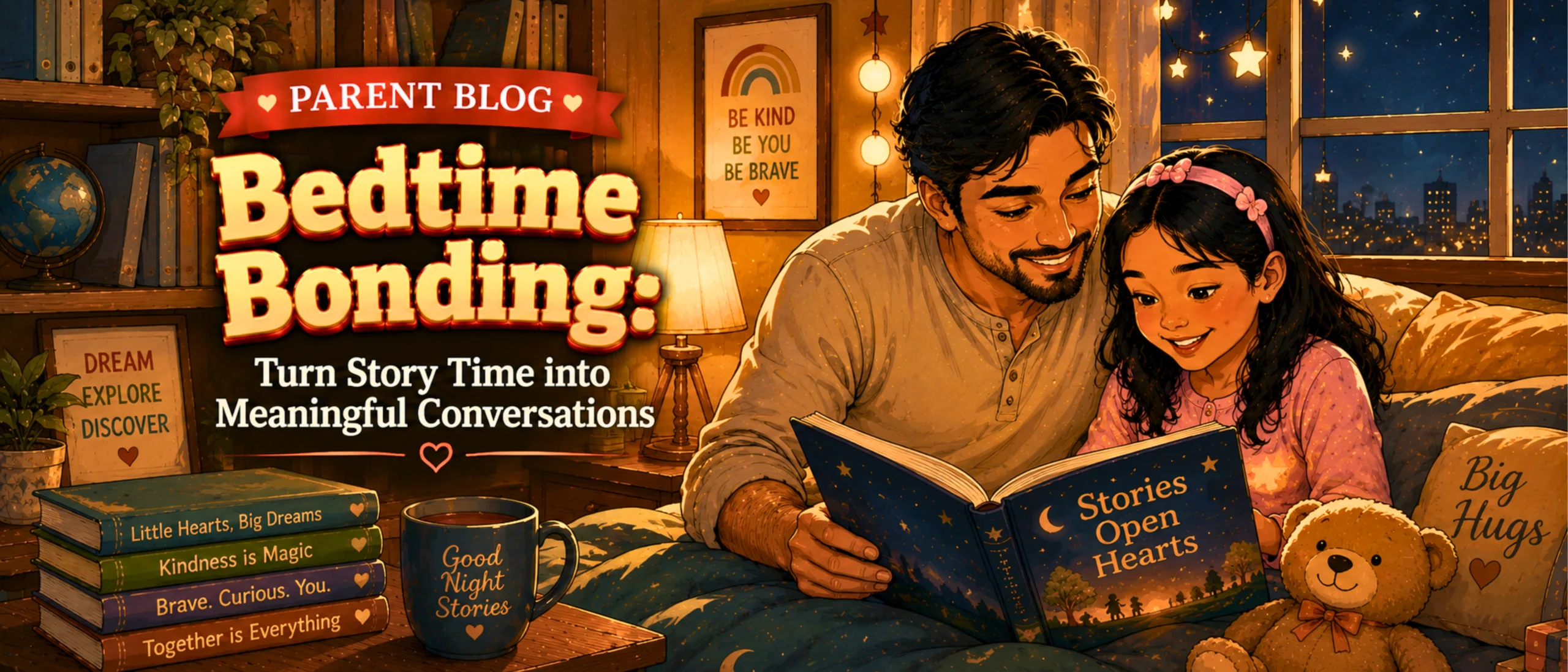
The soft glow of a bedside lamp. A favorite book waiting to be opened. Your child snuggled close beside you.
Bedtime reading can become one of those special family routines that children remember for years. But reading together can offer much more than a quiet end to the day. Stories give parents and children a natural chance to talk, laugh, wonder, ask questions, explore feelings, and connect stories to real life.
You do not need to turn story time into a lesson.
Sometimes, all it takes is one good question.
Why Bedtime Stories Can Start Meaningful Conversations
Family life can be busy. Between school, meals, homework, activities, and everyday responsibilities, there is not always much time to simply sit and talk.
Bedtime can be different.
The day begins to slow down. There are fewer distractions. You are sitting together and sharing the same story.
Stories also make it easier to talk about feelings and experiences.
Instead of asking your child a difficult question about their own life, you can begin with a character.
“Why do you think she did that?”
“Do you think he made the right choice?”
“What would you have done?”
Your child is talking about the character, but the conversation may naturally lead to their own thoughts and experiences.
Go Beyond “Did You Like the Story?”
There is nothing wrong with asking your child if they enjoyed a book.
But a question like:
“Did you like it?”
may only get:
“Yes.”
Instead, ask questions that give your child more to talk about.
Encourage them to predict what will happen, explain a character’s choice, imagine a different ending, or connect the story to something in their own life.
You do not need to stop and ask a question on every page. Choose moments that feel natural.
Most importantly, do not turn story time into a quiz.
You are not trying to find out if your child discovered the “correct” lesson.
You are interested in what they noticed and what they think.
10 Questions to Ask During Bedtime Reading
Try some of these questions the next time you read together:
- “What do you think is going to happen next?”
- “Why do you think the character made that choice?”
- “How do you think the character is feeling right now?”
- “What would you do if you were in that situation?”
- “Was there another way the character could have solved the problem?”
- “Have you ever felt the way this character feels?”
- “Which character would you most like to meet? Why?”
- “What was your favorite part of the story?”
- “If you could change one part of the story, what would you change?”
- “What do you think happens after the story ends?”
There does not have to be a correct answer.
Sometimes, the answer you were not expecting can lead to the best conversation.
Use Stories to Talk About Feelings
Stories can make it easier for children to talk about emotions.
Imagine you are reading about a character who is nervous about trying something new.
Instead of immediately asking your child:
“What are you afraid of?”
start with the character:
“Why do you think the character feels nervous?”
Then you could ask:
“What do you think might help?”
Later, if it feels natural, you might ask:
“Have you ever felt like that?”
The conversation starts with the character and slowly moves toward your child’s own experiences.
Stories can also help families talk about friendship, kindness, courage, disappointment, responsibility, patience, money, family relationships, problem-solving, and making safe choices.
Try It with Critter Chronicles: Talking About Courage
In Petra’s First Flight, Petra faces the challenge of taking her first flight.
After reading the story, you could ask:
“What’s something new you’re learning that feels a little scary?”
Then:
“What helps you feel brave when you’re trying something new?”
Petra’s adventure can become a simple starting point for talking about courage, fear, preparation, and not giving up.
Children do not have to begin by talking about themselves. Sometimes it is easier to explore a feeling through a character first.
Use Stories to Talk About Difficult Topics
Some subjects can be difficult to bring up directly, especially with younger children.
Stories can help.
A character who wants something they cannot afford can start a conversation about saving, spending, wants, and needs.
A character who wanders away can lead to a discussion about safety and responsibility.
A character who makes a mistake can open a conversation about honesty, consequences, forgiveness, and trying again.
A story with characters who have different opinions can help children think about empathy and understanding other people.
You do not need to force a lesson into every story.
If a good conversation begins naturally, follow it.
Use Story Time to Build Thinking Skills
Talking about stories is not only useful for exploring feelings. It can also help children think more deeply.
To explore cause and effect, ask:
“What do you think would have happened if the character had made a different choice?”
To help your child see another person’s point of view, ask:
“Do you think the other character saw the situation differently?”
To encourage problem-solving, ask:
“What else could they have tried?”
To connect the story to real life, ask:
“Does this remind you of anything that has happened to us?”
To encourage imagination, ask:
“If you could join this adventure, where would you go?”
These questions help children think about why things happened, what could happen next, and how a story may connect to the world around them.
Let Your Child Lead the Conversation
Parents often notice a message or lesson in a story.
Your child may notice something completely different.
Perhaps you expect a story to start a conversation about bravery, but your child is more interested in the friendship between two characters.
Follow their interest.
You could ask:
“What did you notice about their friendship?”
Or:
“Why do you think that part was important?”
Your child’s answer can help you understand what stood out to them.
Sometimes the best conversations happen when we stop trying to guide every part of them.
Create a Simple Bedtime Reading Routine
You do not need a complicated routine to make bedtime reading meaningful.
1. Get Comfortable
Choose a comfortable place where you can share the book and see your child’s expressions and reactions.
2. Create a Little Curiosity
Before you begin, give your child a small clue about the story.
For example:
“Tonight we’re meeting a character who has a big decision to make. I wonder what they’ll choose.”
This can make your child curious before you even turn the first page.
3. Pause at Interesting Moments
You do not always need to wait until the end of the story to talk.
At an exciting moment, pause and ask:
“What do you think will happen next?”
4. Accept Unexpected Answers
Children do not always see stories in the same way adults do.
If your child gives an answer you did not expect, try:
“That’s interesting. What made you think that?”
You may discover something you had not noticed yourself.
5. Connect the Story to Their Life
When it feels natural, you can ask:
“Have you ever felt like that?”
Or share a family connection:
“That reminds me of when we…”
6. Connect Stories Together
Children often enjoy remembering characters or events from other books.
You might ask:
“Remember another character who had a problem like this? What did they do?”
This helps children compare stories and remember what they have read.
7. Know When to Simply Read
Not every bedtime story needs a conversation.
Some nights your child may have lots of questions.
Other nights they may simply want to cuddle, listen to the story, and go to sleep.
Both are valuable.
A meaningful story time is not measured by how many questions you ask.
Don’t Quiz—Be Curious
If you remember one thing, make it this:
You do not need to quiz your child. Be curious with them.
Instead of asking:
“What lesson did you learn?”
try:
“What did you think about that?”
Instead of:
“Why was that the wrong thing to do?”
try:
“Why do you think the character made that choice?”
The difference is small, but important.
One question asks your child to find the answer you are looking for.
The other invites them to share what they think.
Looking for Stories That Start Conversations?
Critter Chronicles stories are created to entertain children while also opening the door to meaningful learning.
Through animal characters and engaging adventures, children can explore ideas such as courage, kindness, friendship, financial literacy, responsibility, problem-solving, perseverance, curiosity, and empathy.
These ideas do not need to become formal lessons at bedtime.
Read the story.
See what your child notices.
Ask a question when it feels natural.
Then let the conversation grow from there.
Make the Moments Matter
Bedtime reading does not need to be about finishing a certain number of books or finding a lesson in every story.
Sometimes the most meaningful moment is when your child suddenly says:
“That happened to me.”
Or asks:
“Why did they do that?”
Or shares an idea you never expected.
These small conversations can turn reading from something you do for your child into something you experience together.
So tonight, choose a story.
Get comfortable.
Read together.
Pause when something makes you both wonder.
Follow your child’s curiosity.
And if the conversation takes you somewhere unexpected, let it.
Sometimes the most meaningful part of story time begins when you stop reading and start talking.