
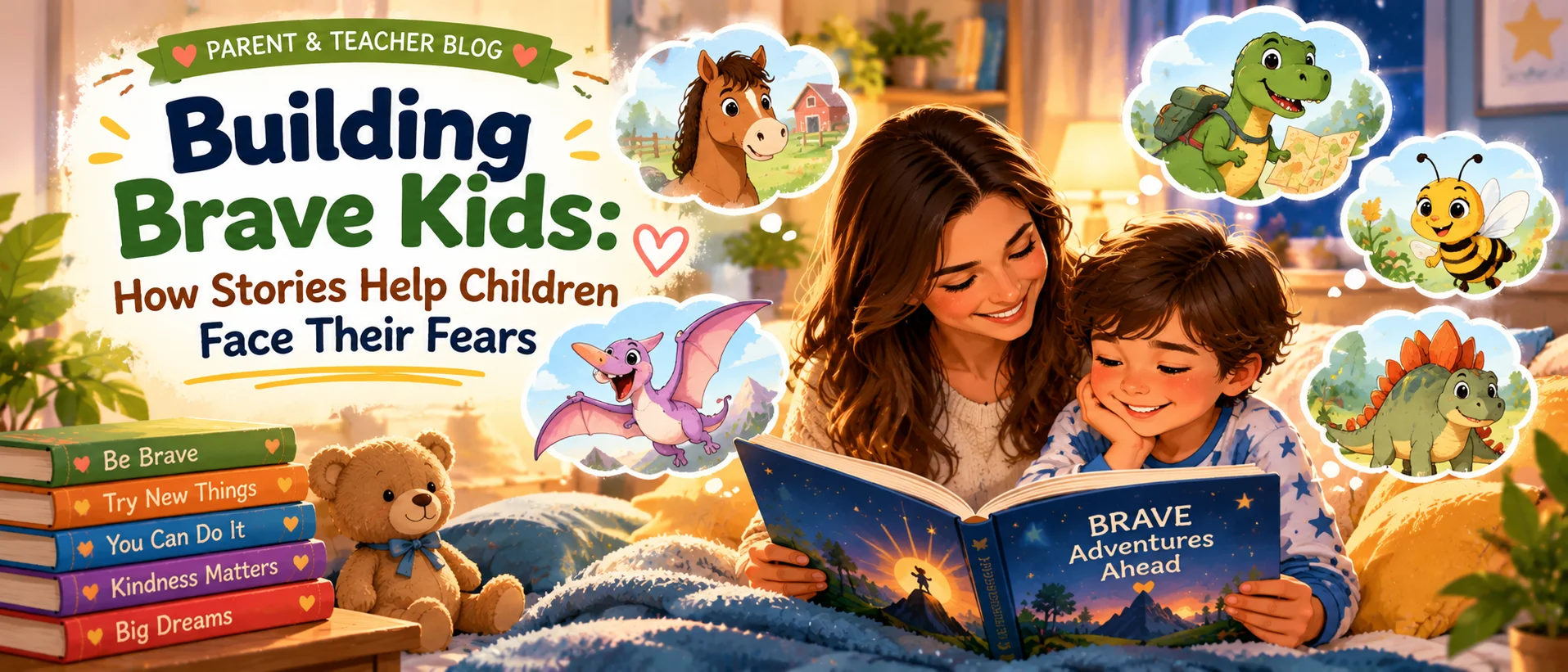
Stories help children face their fears by giving them relatable characters, meaningful challenges, and safe opportunities to explore courage.
From climbing the playground ladder to meeting new people, childhood is filled with moments that require courage.
Trying something unfamiliar, making a mistake, starting school, being away from parents, speaking in front of others, or simply facing something that feels scary can all be challenging for children.
Parents naturally want to protect children from distress. Teachers want children to feel safe and supported.
But helping children develop courage doesn’t mean telling them not to be afraid.
It means helping them understand that being afraid and being brave can happen at the same time.
Stories can be a powerful way to explore that idea.
Characters such as Henry Horse, who worries about whether his farm life is meaningful, or Petra Pterodactyl, who faces the challenge of her first flight, give children opportunities to see characters experience fear, make decisions, try strategies, and keep moving forward.
Instead of simply telling children to “be brave,” stories allow them to see courage in action.
Why Stories Can Help Children Explore Fear
When adults tell a child:
“There’s nothing to be afraid of.”
or:
“Just be brave.”
the words may not make the fear disappear.
Stories offer another approach.
A child can watch a character experience a difficult situation from a comfortable distance.
They can wonder:
“Why is the character scared?”
“What could they do?”
“What would I do?”
This distance can make difficult emotions easier to explore.
The child isn’t being told that they are afraid or that they are handling something incorrectly.
Instead, they are thinking about a character.
And sometimes, that fictional conversation naturally opens the door to a very real one.
Stories Create a Safe Space to Explore Courage
Imagine Henry Horse feeling that his everyday farm life isn’t exciting or important.
A child who has ever wondered whether they are good enough, important enough, or capable enough may recognize something familiar in Henry’s experience.
Or imagine Petra facing her first flight.
A child who is nervous about trying something new may see their own uncertainty reflected in Petra.
Stories can help children understand that:
- Fear is something many people experience.
- Being afraid doesn’t mean being weak.
- Courage doesn’t mean feeling no fear.
- Challenges can be approached one step at a time.
- Learning and preparation can make difficult situations feel more manageable.
The story creates space for children to think about these ideas without requiring them to immediately talk about themselves.
How Different Characters Can Represent Different Fears
One strength of character-based children’s stories is that different characters can provide different ways to explore common childhood concerns.
Henry Horse: Fear of Inadequacy
Henry’s journey from wondering whether his farm life is meaningful to discovering the value of what horses contribute can help children explore questions about their own abilities and importance.
Ask:
“What made Henry feel unsure about himself?”
“What did Henry discover about what he could do?”
“What are you really good at?”
The conversation can help children think about strengths that they may not always recognize in themselves.
Petra Pterodactyl: Fear of Failure
Petra’s first-flight experience provides an opportunity to talk about trying something new when success isn’t guaranteed.
Ask:
“How do you think Petra felt before her first flight?”
“What helped her prepare?”
“Have you ever been nervous about trying something for the first time?”
Children can begin to see courage not as being perfect, but as being willing to try.
Tucker T-Rex: Fear of Separation
Tucker’s dragonfly chase and resulting separation from his parents can help children explore concerns about getting lost or being separated from people they trust.
Parents and teachers can ask:
“How do you think Tucker felt when he realized he was separated?”
“What could help someone feel safer in that situation?”
This can create a gentle starting point for age-appropriate conversations about safety and staying connected.
Spike Stegosaurus: Fear of the Unknown
Spike’s encounter with an Allosaurus provides an opportunity to discuss unexpected and challenging situations.
Ask:
“What do you think Spike was thinking?”
“What could someone do when something unexpected happens?”
Children can explore the idea that they may not always know exactly what will happen next, but they can still think about possible responses.
Buzzy Bee: Fear of Change
Buzzy’s first day learning about different bee jobs can help children explore transitions and unfamiliar experiences.
This can be especially useful when children are:
- Starting school
- Moving classrooms
- Meeting new people
- Trying a new activity
- Learning a new routine
Ask:
“What was new for Buzzy?”
“What helped Buzzy learn?”
“What could help you when something feels new?”
Help Children Build a Courage Vocabulary
One of the most useful things stories can provide is language.
Children may feel fear without knowing how to describe it.
A story can introduce words such as:
- Nervous
- Worried
- Uncertain
- Frightened
- Courageous
- Confident
- Proud
- Determined
- Curious
- Prepared
When children can name what they are experiencing, it can become easier to talk about what might help.
Name the Emotion
Ask:
“How do you think the character feels?”
Notice Physical Feelings
Ask:
“What happens in their body when they’re scared?”
Children might notice:
- A fast heartbeat
- Tight muscles
- A funny feeling in their stomach
- Wanting to hide
- Feeling shaky
Identify Courage Strategies
Ask:
“What helped the character keep going?”
This helps children understand that courage can involve preparation, asking for help, practising, learning, and taking small steps.
From Passive Listening to Active Courage
Simply reading a story can be enjoyable.
But parents and teachers can extend the experience through simple activities.
1. Character Connection Conversations
Ask open-ended questions:
“When have you felt scared like Petra?”
“What helped Henry feel brave enough to try something new?”
Let the child decide how much they want to share.
2. Courage Role-Play
Invite children to act out how a character handled a challenge.
For example:
“Pretend you’re Petra preparing for her first flight. What could you do before trying something difficult?”
Role-play gives children an opportunity to practise responses rather than simply hear about them.
3. Create a Fear-to-Brave Map
Draw a simple pathway:
FEAR → THINK → TRY → KEEP GOING
Then use a story character as an example.
Afterward, children can create their own pathway for a challenge they are comfortable discussing.
4. Build a Bravery Bridge
Help children connect a character’s strategy to a real-life situation.
For example:
“Petra learned about flying before taking her first flight. What could you learn before your first day at school?”
This turns a story experience into a practical problem-solving exercise.
5. Create Character Inspiration Cards
Create simple cards featuring story characters and a short courage reminder.
For example:
“Brave doesn’t mean never being scared.”
Or:
“Take one small step.”
Children can keep the cards somewhere they can see them when facing a new challenge.
Using Stories to Explore Sensitive Fears
Some fears can be more difficult for children to discuss directly.
These may include:
- Family changes
- Medical experiences
- Natural disasters
- Separation
- Moving
- New environments
- Significant changes in routine
Stories can provide some psychological distance.
Instead of immediately asking:
“Are you scared about your appointment?”
a parent might begin with a character:
“How do you think the character felt when they had to do something unfamiliar?”
This doesn’t mean every difficult fear should be addressed through a story alone.
For more serious or persistent concerns, children may need additional support from parents, teachers, or appropriate professionals.
The purpose of the story is to create a gentle starting point for conversation.
What Children Can Learn From Brave Characters
Courage stories can help children explore several important ideas.
1. Fear Is Normal
Even capable characters can experience fear.
2. Fear Doesn’t Define You
Being afraid doesn’t mean a child is weak.
3. Challenges Can Change
A difficult moment doesn’t necessarily stay difficult forever.
4. There Isn’t One Way to Be Brave
One child may ask for help.
Another may practise first.
Another may take a small step.
Another may need more time.
5. Preparation Can Build Confidence
Learning what to expect and practising a skill can make unfamiliar situations feel more manageable.
How Different Ages Can Engage With Courage Stories
Children’s understanding of courage develops alongside their growing ability to understand emotions, choices, and consequences.
Ages 2–4
Keep courage concepts simple and concrete.
Focus on:
- Trying something new
- Asking for help
- Helping others
- Taking a small brave step
Ages 4–6
Children can begin exploring:
- Feelings
- Simple coping strategies
- Problem-solving
- Preparing for new experiences
Characters such as Petra can provide accessible examples.
Ages 6–8
Children can explore more complex ideas such as:
- Standing up for others
- Persevering through difficulty
- Managing disappointment
- Making difficult choices
- Understanding different perspectives
Ages 8+
Older children may be ready to explore:
- Moral courage
- Intellectual curiosity
- Failure
- Responsibility
- Taking thoughtful risks
- Standing up for what they believe is right
Professor Owlbert’s willingness to explore new theories can provide a starting point for conversations about curiosity and intellectual courage.
Create a Courage-Building Reading Routine
You don’t need a complicated program.
A few simple habits can make story-based courage discussions part of everyday reading.
1. Match Stories to Current Challenges
Choose stories that relate to something your child may currently be experiencing.
For example:
- Starting school
- Meeting new people
- Trying a new activity
- Making mistakes
- Being away from parents
- Facing a new environment
2. Read Proactively
Don’t wait until a child is already overwhelmed.
A courage-themed story can be introduced before an anticipated challenge.
Reading about a character facing something unfamiliar can give children an opportunity to think about possible responses beforehand.
3. Notice Real-Life Moments of Courage
When your child does something brave, connect it to the story.
You might say:
“That reminded me of Petra. You were nervous, but you tried anyway.”
This helps children recognize their own actions as examples of courage.
4. Create Courage Catchphrases
Simple phrases can be easier for children to remember.
For example:
“One small step.”
“Brave like Petra.”
“I can try.”
“I can ask for help.”
Keep the phrase positive and realistic for the child’s age.
5. Build Story Collections Around Specific Fears
Families and teachers can create small collections of stories around themes such as:
- New experiences
- Separation
- Doctor visits
- Nighttime fears
- Friendship
- Failure
- Trying again
The goal isn’t to make children read about their fears repeatedly.
It’s to give them different characters and situations through which they can explore courage.
The Long-Term Value of Brave Stories
The characters children meet in stories can become familiar examples they remember when facing their own challenges.
A child may remember:
“Petra was scared to fly, but she prepared and tried.”
Or:
“Henry thought he wasn’t important, but he discovered what he could contribute.”
These story memories can become useful conversation points long after the book has been closed.
The most important message isn’t:
“Don’t be afraid.”
It’s:
“You can be afraid and still take a thoughtful next step.”
That distinction matters.
Building Brave Kids, One Story at a Time
Children don’t become brave because an adult tells them to “be brave.”
Courage develops through experiences, supportive relationships, practice, and opportunities to face manageable challenges.
Stories can become one part of that process.
A character can feel afraid.
A character can make a mistake.
A character can ask for help.
A character can try again.
And eventually, a character can discover:
“I can do something that once felt impossible.”
That’s the kind of message children can carry beyond the pages of a book.
So the next time your child faces something unfamiliar, choose a story.
Meet a character who has been scared.
Talk about what happened.
Ask what the character could try.
Then, when your child faces their own challenge, remind them:
Courage doesn’t mean never being afraid.
Sometimes courage simply means taking the next small step.
FAQ
How can stories help children face their fears?
Stories allow children to explore fear and courage through characters and situations. They can observe how a character responds to a challenge and then discuss strategies they might use themselves.
Do stories really help children become more courageous?
Stories can provide opportunities to discuss fear, practise problem-solving, and explore different responses to challenging situations. They work best as one part of a broader supportive environment rather than as a replacement for real-world support.
What are good children’s stories for teaching courage?
Stories featuring characters who face manageable challenges, make choices, ask for help, practise skills, and keep trying can provide useful opportunities to discuss courage.
How can parents talk to children about fear?
Start with open-ended questions and avoid dismissing the child’s feelings. Talking about a story character can be an easier starting point than asking children directly about their own fears.
How can teachers use courage stories in the classroom?
Teachers can use stories for group discussions, role-play, problem-solving activities, feelings vocabulary, character comparisons, and discussions about trying new things or responding to challenges.
What is the difference between courage and not being afraid?
Courage doesn’t require the absence of fear. A child can feel nervous or scared while still taking a safe, thoughtful step forward.
What courage activities can children do after reading a story?
Children can create fear-to-brave maps, act out character situations, make courage cards, discuss alternative choices, or connect a character’s strategy to an age-appropriate real-life challenge.
Should parents force children to face their fears?
The blog’s story-based approach focuses on understanding fear, building skills, and taking manageable steps rather than simply forcing children into frightening situations. For serious or persistent fears, parents should consider appropriate additional support.
How can Critter Chronicles support courage-building?
Characters such as Henry Horse, Petra Pterodactyl, Tucker T-Rex, Spike Stegosaurus, and Buzzy Bee provide different story situations that can open conversations about confidence, fear, separation, uncertainty, change, problem-solving, and courage.