
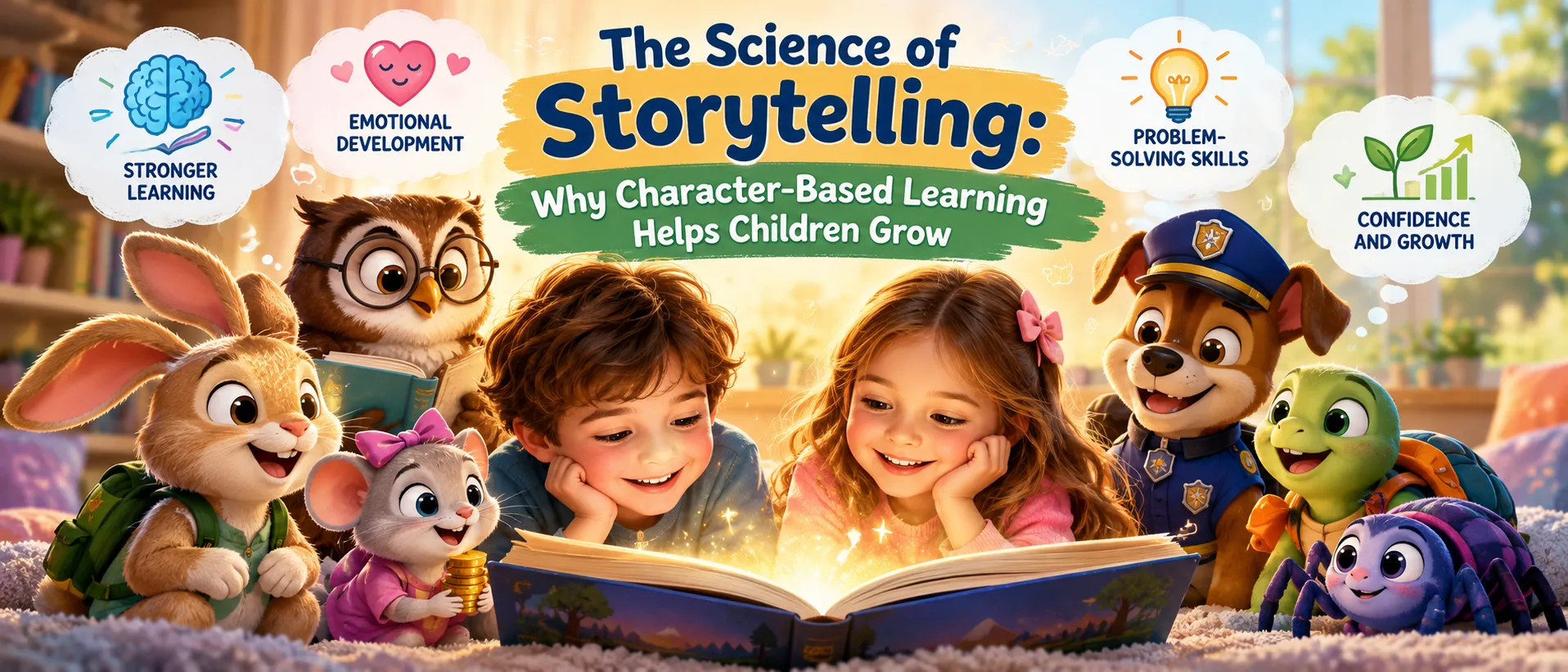
The Science of Storytelling helps explain why engaging stories and memorable animal characters can be powerful tools for children’s learning and development. Parents have long understood the magic of a good story, and research into child development, psychology, and education continues to explore how storytelling supports memory, language, emotional understanding, and problem-solving.
When children follow lovable animal characters through exciting adventures, they do more than enjoy a good tale. They encounter new ideas, explore emotions, consider different perspectives, and discover ways to understand the world around them.
From Benny Bunny learning to save money to Max the Police Pup demonstrating responsibility, memorable characters can turn unfamiliar concepts into relatable experiences. With thoughtful storytelling and opportunities to apply lessons in everyday life, parents can encourage children to develop confidence, curiosity, empathy, and essential life skills.
The Science of Storytelling: How Children Connect with Characters
Why do children become so attached to fictional characters? The answer lies partly in how children learn through observation, emotional engagement, imagination, and repeated experiences.
Learning Through Observation
Children frequently learn by observing others’ actions, decisions, and reactions. Stories give them opportunities to watch characters face challenges, explore possible solutions, and experience the consequences of their choices.
When children follow characters such as Max the Police Pup or Pixel the Spider, they can observe how different approaches lead to different outcomes.
For example, Pixel might encounter a difficult puzzle and feel frustrated before discovering a solution through patience and experimentation. Children can use this experience as a starting point for discussing persistence and creative thinking.
Parents can reinforce the lesson by asking, “What would you try if you were Pixel?” or “What could Pixel do differently next time?”
These conversations encourage children to think beyond the events of the story and consider how its lessons might apply to their own lives.
Stories Make New Ideas Easier to Explore
Some topics can be difficult for young children to understand when presented through explanations alone. Storytelling offers an engaging alternative by placing new ideas within familiar, meaningful situations.
Psychologists sometimes describe becoming mentally immersed in a story as narrative transportation. When readers become absorbed in a character’s experiences, they may find it easier to consider unfamiliar situations and perspectives.
For example, a character who feels nervous about starting school can help children discuss their own worries. A character learning to share can introduce conversations about kindness, fairness, and friendship.
Stories do not replace real-world experiences, but they can provide a comfortable starting point for exploring challenging feelings and new concepts.
How Emotional Connections Help Children Remember Stories
Have you ever noticed a child remembering a favorite character’s adventure long after forgetting an ordinary instruction?
Emotionally engaging experiences can support memory formation. When children feel curious, excited, concerned, or happy while following a story, those emotions may help make important moments more memorable.
Emotional Connections Make Lessons Meaningful
Consider Mira Mouse, a character who wants to buy something special.
Instead of simply telling children that saving money is important, her story can show her setting a goal, making thoughtful choices, and experiencing the satisfaction of reaching it.
This approach introduces financial concepts through a relatable experience. Parents can extend the lesson by helping children create a savings jar, choose a simple goal, or track their progress.
Similarly, Tucker’s adventure might introduce perseverance, while another character’s mistake could encourage a conversation about honesty and responsibility.
The goal is not simply to make children feel excited. It is to connect those feelings with meaningful ideas they can understand and practice.
Story Structure Supports Understanding and Recall
Stories typically have a beginning, a middle, and an end. This structure helps children follow events, recognize patterns, and understand how actions connect to consequences.
Consider Benny Bunny’s savings adventure:
- The challenge: Benny wants a new toy.
- The decision: He decides to save a little money each week.
- The obstacle: He feels tempted to spend his savings on something else.
- The outcome: He practices patience and eventually reaches his goal.
By following Benny’s journey, children can explore the relationship between planning, choices, effort, and outcomes.
Parents can strengthen this experience by asking children to retell the story, predict what might happen next, or explain why a character made a particular decision.
These activities encourage comprehension, reasoning, and independent thinking.
Character Identification Builds Empathy and Understanding
Children often connect deeply with fictional characters, particularly when their feelings and experiences resemble their own.
This connection gives children opportunities to imagine different perspectives, recognize emotions, and think about how their actions affect others.
Practicing Perspective-Taking
When children identify with characters such as Professor Owlbert or Luna Moth, they can explore unfamiliar situations from another point of view.
A story about a character who feels left out, for instance, can introduce a conversation about loneliness and inclusion. A character who apologizes after making a mistake can demonstrate responsibility and the importance of repairing relationships.
Parents can encourage perspective-taking with simple questions:
- How do you think the character feels?
- Why do you think the character made that choice?
- What could the character do differently?
- What would you do in the same situation?
There are no always-right answers to these questions. The purpose is to help children consider different possibilities and express their thoughts.
Familiar Characters Encourage Continued Engagement
Children may develop strong attachments to fictional characters they encounter repeatedly. Although these relationships are one-sided, the enjoyment and emotional connection children experience can be genuine.
A familiar character can make a new story feel inviting and encourage children to return to a series.
For example, a child might first learn about friendship through one of Benny Bunny’s adventures and later explore teamwork, forgiveness, or conflict resolution through another story featuring the same character.
This continuity creates opportunities to revisit earlier lessons while introducing more complex ideas as children grow.
Why the Science of Storytelling Engages Multiple Learning Skills
A well-designed children’s story combines language, illustrations, emotions, imagination, and opportunities for interaction. Together, these elements can create a rich and engaging learning experience.
1. Visual Learning Through Colorful Characters
Distinctive characters, expressive faces, and colorful illustrations help children identify important details and follow what is happening in a story.
For example, Octavia’s changing blue skin could help children explore a story about emotions, adaptation, or changes in the environment, depending on the storyline.
Illustrations also provide visual clues that help children connect words with actions, objects, and feelings.
2. Language and Vocabulary Development
Character dialogue and descriptive storytelling expose children to new words, sentence structures, and different ways of expressing themselves.
When parents read aloud, explain unfamiliar words, and invite children to predict what a character might say, they create opportunities for language development.
Over time, shared reading can support vocabulary growth, listening comprehension, and an interest in reading.
3. Emotional Awareness and Self-Regulation
Characters experience many emotions, including excitement, disappointment, frustration, pride, and sadness.
Watching characters navigate these experiences can help children recognize feelings and consider ways to respond.
For instance, a story about Buzzy learning to manage frustration could lead to a discussion about taking a deep breath, asking for help, or trying again.
Parents can connect these lessons to real situations by encouraging children to name their feelings and think about what might help them.
4. Movement, Imagination, and Active Participation
Stories involving movement can inspire children to act out events, imitate characters, and participate more actively in reading.
Children might flap their arms like a flying character, move like Spike, or act out a character’s journey around the room.
Parents can also use simple props, drawings, or role-play to bring a story to life.
These activities make reading interactive and create additional opportunities for children to express ideas through movement and imagination.
How Familiar Characters Create a Foundation for New Learning
One advantage of recurring characters is that children do not need to learn everything about them from the beginning.
Once children understand a character’s personality, habits, and motivations, they can focus more attention on the new situation or concept introduced in the next story.
Building Mental Frameworks
Children organize new information by connecting it with what they already know. These mental frameworks, often called schemas, help them make sense of new experiences.
Familiar characters can provide a recognizable starting point for introducing unfamiliar material.
For example, Billy Bird might introduce counting in one story and explore addition or simple patterns in a later adventure.
Because children already understand Billy’s character, they have a familiar context in which to encounter new ideas.
The Value of Repetition
Children often ask to hear the same story repeatedly. Although this repetition may seem predictable to adults, it can serve an important learning purpose.
Each rereading gives children another opportunity to notice details, understand unfamiliar language, anticipate events, and revisit important lessons.
Parents can make repeated reading more engaging by changing the questions they ask. The first reading might focus on what happened, while the next explores why it happened or what the character could do differently.
Revisiting ideas across different stories and real-life situations can also help children build stronger connections between what they hear and what they experience.
Five Practical Ways Parents Can Use Character-Based Learning
You do not need specialized educational materials to turn a favorite story into a learning opportunity. A few simple habits can help connect fictional adventures with everyday life.
1. Connect Story Lessons to Real Life
When your child encounters a relevant situation, remind them of a character’s experience.
For example, you might say, “Remember how Benny Bunny saved his money? Let’s think about how we can save for something special, too.”
This helps children explore how ideas from stories can apply to their own decisions.
2. Encourage Children to Think Like Their Favorite Characters
When your child faces a manageable challenge, invite them to consider what a familiar character might do.
Ask, “How might Sara Squirrel solve this problem?”
Encourage your child to suggest several possible solutions rather than looking for one perfect answer. This can support creative thinking and help them consider the consequences of different choices.
3. Extend Learning Beyond the Story
Use a character’s interests as a starting point for further exploration.
If Vera Velociraptor introduces dinosaurs, look at dinosaur books together, compare different species, or learn how scientists discover fossils.
If a character explores nature, take a walk and identify different plants, insects, or birds.
These activities turn a fictional adventure into an opportunity for real-world discovery.
4. Embrace Repeated Reading
If your child repeatedly requests the same story, use that enthusiasm to build deeper understanding.
Try discussing a new illustration, asking your child to retell the story in their own words, or inviting them to imagine an alternative ending.
Let your child’s age, attention span, and interests guide the experience. Reading should remain enjoyable rather than feel like a test.
5. Connect Lessons Across Different Characters
Children can benefit from encountering similar ideas in different situations.
Henry Horse might introduce different occupations, while Max the Police Pup explores community helpers and responsibility.
Comparing their experiences can help children recognize broader themes and understand how cooperation, patience, kindness, and responsibility apply in different contexts.
The Lasting Value of the Science of Storytelling
Early childhood is an important period for developing language, memory, social understanding, and problem-solving skills. Stories can contribute to these areas by giving children opportunities to listen, imagine, discuss, and reflect.
The most meaningful learning experiences often extend beyond the page. When children talk about a character’s decisions, connect story events to their own lives, and practice new skills, they can begin turning fictional examples into practical understanding.
A beloved animal character is not a substitute for real-world experience, supportive relationships, or effective teaching. Instead, it can serve as a bridge between an unfamiliar idea and something a child already understands.
Parents can make the most of this opportunity by reading together, encouraging questions, revisiting meaningful lessons, and allowing children to explore their own interpretations.
The next time your child asks to read about Benny Bunny, Max the Police Pup, or another favorite character, remember that the experience can be about more than entertainment.
It can be a chance to explore emotions, develop language, practice reasoning, and make sense of the world—one story at a time.
The science of storytelling reminds us that when children connect with a story, they gain more than a character to love. They gain another way to learn.
Frequently Asked Questions (FAQs)
1. What is the science of storytelling?
The science of storytelling explores how stories engage attention, emotions, memory, and imagination. In children’s learning, storytelling can help introduce new ideas through relatable characters, meaningful events, and situations children can understand.
2. How does character-based learning help children?
Character-based learning introduces concepts through memorable characters and their experiences. It can encourage children to explore problem-solving, empathy, responsibility, language, and emotional awareness while enjoying a story.
3. Why are animal characters effective in children’s stories?
Animal characters can make stories appealing and approachable for young readers. Their adventures provide opportunities to explore emotions, choices, friendships, and everyday challenges in an imaginative setting.
4. Can storytelling improve children’s memory?
Storytelling can support memory by presenting information in a meaningful sequence and connecting it with engaging experiences. Repeated reading, retelling stories, and discussing important events can further reinforce understanding and recall.
5. How can stories help children develop emotional intelligence?
Stories introduce characters who experience emotions such as happiness, frustration, sadness, and excitement. Discussing how characters feel and respond to challenges can help children recognize emotions, consider different perspectives, and explore appropriate responses.