
Description
Cut the letters. Sound out the word. Build it yourself!
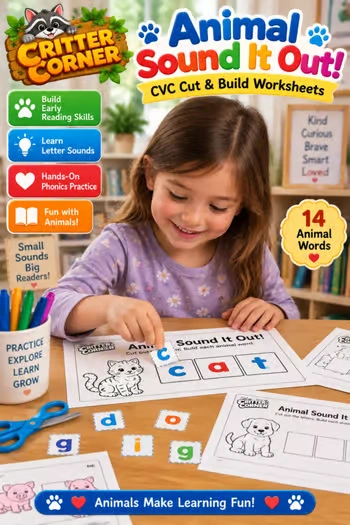
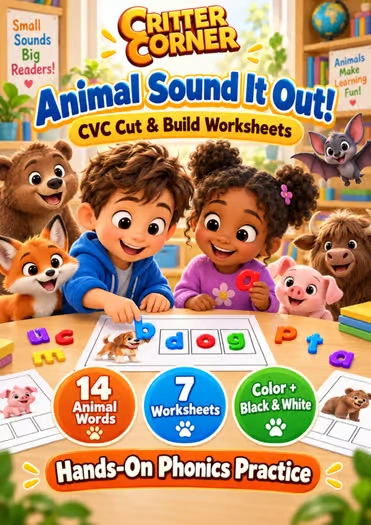
Animal Sound It Out! is a hands-on printable phonics activity designed to help beginning readers practice CVC words, letter sounds, blending, segmenting, spelling, and word building using familiar animal pictures and movable letter pieces.
Instead of simply copying a completed word, children look at an animal picture, identify its name, listen carefully to the sounds they hear, and choose the correct letters to build the word.
Look → Say → Sound It Out → Choose → Build
Children ask:
- What animal do you see?
- What sound do you hear first?
- What vowel sound is in the middle?
- What sound do you hear at the end?
Then they physically move the letters into three boxes to build the animal’s name.
What’s Included
This 16-page printable phonics resource includes:
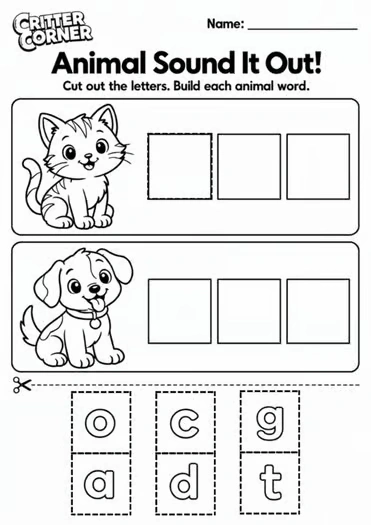
- 7 black-and-white CVC worksheets
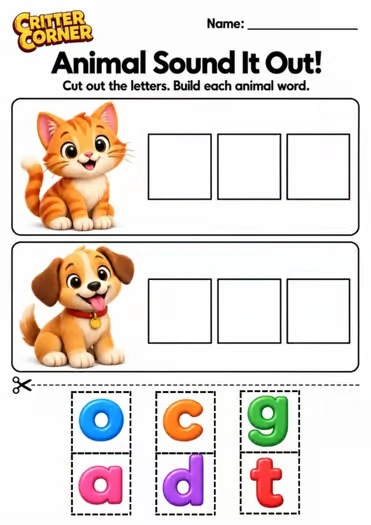
- 7 matching full-color CVC worksheets
- 14 animal CVC words
- 2 animal words per worksheet
- 3 sound/letter boxes for each animal
- 6 cut-apart lowercase letter choices per worksheet
- Dashed cutting guides
- Name lines
- Child-friendly directions
- Teacher Tip
- Full-color and black-and-white movable letter pieces
- Product cover, printing instructions, and copyright page
14 Animal CVC Words
Children practice building these familiar three-letter animal words:
cat • dog • pig • hen • fox • bat • rat • ram • yak • hog • cod • bug • cub • pup
Using recognizable animal pictures helps children connect the sounds and letters they are building with a word they already understand.
How Does Animal Sound It Out! Work?
Each worksheet features two animal pictures, three empty boxes for the letters, and six cut-apart lowercase letter choices.
Children figure out which three letters belong to each animal and place them into the correct boxes.
For example:
CAT
Children listen:
/c/ – /a/ – /t/
Then find:
c + a + t
and place the letters into the boxes.
Rather than simply matching a printed word, children are constructing the word from its sounds.
Say It. Stretch It. Build It!
Encourage children to say each animal name slowly before choosing the letters.
For example:
“rrrrr-aaaaa-t”
Then ask:
- What sound do you hear first?
- What sound comes next?
- What sound do you hear at the end?
This strengthens the connection between:
Spoken Sound → Letter → Position → Written Word
What Skills Will Children Practice?
Animal Sound It Out! supports:
- CVC word recognition
- CVC word building
- Phonemic awareness
- Beginning, medial, and ending sounds
- Sound segmentation
- Oral blending
- Letter-sound correspondence
- Short vowel recognition
- Early decoding and encoding
- Beginning spelling
- Word formation
- Lowercase letter recognition
- Visual discrimination
- Problem-solving
- Fine-motor development
- Scissor skills
- Hand-eye coordination
- Independent learning
More Than a CVC Worksheet!
Traditional worksheets may ask children to look at a completed word and copy it. Animal Sound It Out! removes that completed-word prompt.
Children begin with the animal picture and spoken word, identify the sounds they hear, and determine which letters represent those sounds.
This gives children practice with both:
Decoding — connecting letters and sounds to read the completed word.
Encoding — starting with a spoken word and determining which letters are needed to represent its sounds.
Hear the Beginning, Middle & End
Each animal word provides three sounds to investigate.
For example:
DOG
Beginning: /d/
Middle: /o/
End: /g/
HEN
Beginning: /h/
Middle: /e/
End: /n/
PIG
Beginning: /p/
Middle: /i/
End: /g/
Teachers and parents can ask:
“What is the first sound?”
“Can you hear the vowel?”
“What sound closes the word?”
Then children blend the sounds together to check their answer.
Practice Short Vowel Sounds
The animal words give children opportunities to practice short:
a • e • i • o • u
Children hear these vowel sounds within complete CVC words and learn to recognize the vowel as the middle sound.
7 Worksheets for Gradual Practice
Each worksheet contains:
2 animals + 6 letter choices
This keeps the activity manageable for beginning readers. Start with one worksheet at a time, then increase the challenge by combining letters from multiple pages.
Black-and-White + Full-Color Versions
Black-and-White Version
Great for:
- Individual practice
- Coloring
- Scissor practice
- Take-home learning
- Homework
- Lower-ink printing
- One-time use
- Fine-motor centers
Children can color the animals before cutting out the letters and building the words.
Full-Color Version
Ideal for:
- Reusable literacy centers
- Phonics centers
- Morning tubs
- Small groups
- Intervention
- Independent practice
- Homeschool centers
Create a Reusable Phonics Center
For repeated classroom use:
- Print the full-color worksheets.
- Use cardstock or heavier paper.
- Laminate the worksheets and letter pieces.
- Cut apart the letters.
- Store each worksheet and its letters together.
- Let children repeatedly build the words.
For extra durability, add hook-and-loop dots to the letter boxes and pieces.
Adjustable Difficulty
Adapt the activity as children’s phonics skills develop:
Beginning Sound Detectives
Find only the first letter.
Find the Vowel
Give the beginning and ending letters and let children identify the missing middle vowel.
Build the Whole Word
Identify all three sounds and build the complete CVC word.
Mix It Up!
Combine letters from multiple worksheets.
Build It Without the Picture
Say an animal word aloud without showing the picture and let children segment and build it from letters.
More Ways to Play & Learn
Tap the Sounds
Say the animal name and tap once for each phoneme.
c – a – t → 3 sounds → 3 taps → 3 letters
Push the Sounds
Use counters beneath the boxes and push one forward for each sound.
First Sound Hunt
Find animals that begin with a particular sound.
Vowel Detective
Identify the vowel in the completed word.
Change One Sound
Build rat, then change one letter to make bat. Ask which sound changed.
Animal Vocabulary
Talk about where each animal lives, what it eats, and what it looks like.
Perfect For
- Kindergarten
- Beginning Grade 1 readers
- Advanced Pre-K learners
- Homeschool
- Beginning phonics
- CVC word practice
- Short vowel practice
- Beginning, medial, and ending sounds
- Phonemic awareness
- Segmenting and blending
- Early spelling
- Literacy centers
- Phonics centers
- Morning tubs
- Small groups
- Intervention
- Independent practice
- Early finishers
- Take-home learning
- Fine-motor centers
- Animal units
- Beginning readers
Cross-Curricular Learning
Phonics: Practice letter sounds, short vowels, blending, segmenting, decoding, and encoding.
Literacy: Build simple words, strengthen vocabulary, and read completed CVC words.
Fine Motor: Cut, pick up, position, move, and arrange letter pieces.
Science: Use animal pictures to begin discussions about animal characteristics, habitats, and vocabulary.
Speaking & Listening: Say animal names, stretch words, isolate sounds, and explain how each word was built.
Extend the Learning
After building each word, take the activity further:
Say It → Sound It Out → Build It → Read It → Write It
Children can also:
- Draw another CVC animal.
- Sort animal words by medial vowel.
- Create an individual or class Animal CVC Word Book.
- Find rhyming words such as cat → hat, dog → log, hen → pen, and pig → wig.
Teacher Tip
Ask children to touch each letter as they say its sound, then sweep a finger beneath the completed word as they blend.
/c/ → /a/ → /t/
cat!
As children become more confident, gradually reduce prompting and let them take over the complete routine:
Look → Say → Segment → Choose → Build → Blend → Read
Why You’ll Love This Resource
- 14 animal CVC words
- 7 phonics worksheets
- Full-color and black-and-white versions
- Hands-on movable letters
- Three-box word-building format
- Beginning, medial, and ending sound practice
- Short vowel practice
- Phonemic awareness
- Segmenting and blending
- Early spelling skills
- Recognizable animal pictures
- Animal vocabulary development
- Cutting and fine-motor practice
- Easy differentiation
- Reusable with lamination
- Excellent for literacy and phonics centers
- Great for classroom and homeschool learning
- Active, hands-on phonics practice
Small Sounds Build Big Readers!
Reading begins with an important discovery:
Words are made of sounds—and those sounds can be represented by letters.
Animal Sound It Out! gives children the opportunity to make that discovery with their own hands.
They see the animal, say its name, listen to the sounds, search for the letters, and build the word themselves.
One sound. One letter. One box at a time.
Instead of simply being shown the answer, children get to figure it out—building both phonics skills and confidence as beginning readers.
More Critter Corner Phonics Fun!
Pair Animal Sound It Out! with:
- Sound It Out! Hands-On Phonics Reading Practice
- Cook-a-Word! Phonics Games
- A–Z Alphabet Puzzles
- My First Handwriting Workbook
- Build Better Sentences
- CVC Word Activities
- Beginning-Sound Activities
- Alphabet Resources
- Printable Flashcards
- Literacy Centers
- Early Reading Activities


Reviews
There are no reviews yet.