
Description
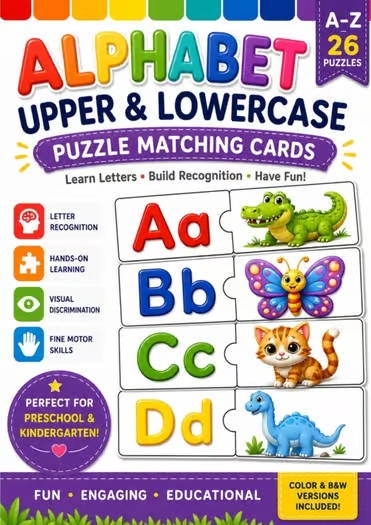
Make alphabet practice hands-on, visual, and engaging with these printable A–Z Alphabet Puzzles for Kids!
Designed for young learners developing early literacy skills, this resource gives children a playful way to practice uppercase and lowercase letter recognition, letter matching, beginning sounds, vocabulary, and alphabet knowledge while also developing fine-motor coordination and problem-solving skills.
Each puzzle connects three important early-literacy concepts:
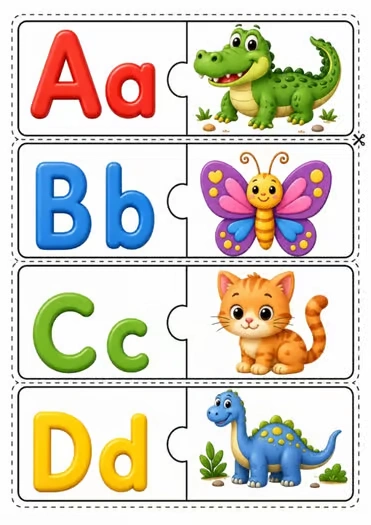
Uppercase Letter + Lowercase Letter + Beginning-Sound Picture
Children identify the letters, name the picture, listen for its beginning sound, and match the three pieces to complete the puzzle.
From A to Z, children are doing more than memorizing the alphabet. They are learning to recognize letters in different forms and connect each letter with a meaningful sound and word.
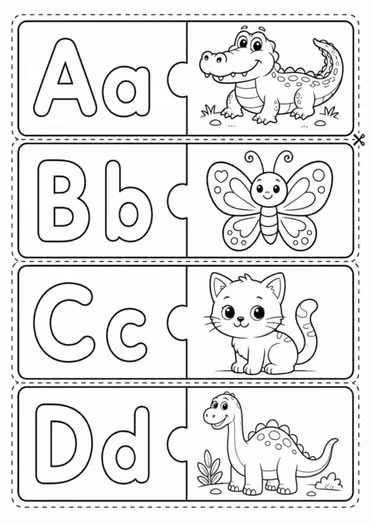
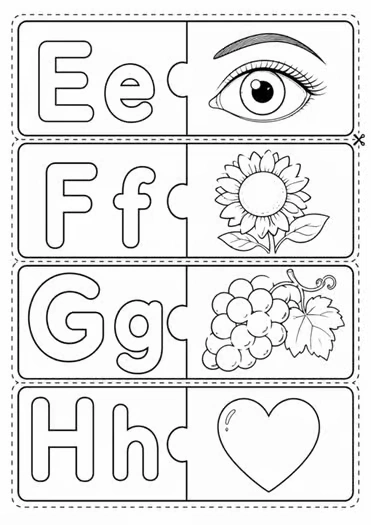
The resource includes both full-color puzzles and matching black-and-white coloring versions, giving teachers and parents flexible options for classroom centers, small groups, independent practice, or learning at home.
What’s Included
This printable A–Z alphabet puzzle resource includes:
- 26 alphabet puzzle sets – A through Z
- Uppercase letter pieces
- Lowercase letter pieces
- Beginning-sound picture pieces
- Full-color 3D-style puzzle versions
- Black-and-white coloring versions
- Clear puzzle-piece divisions
- Cut-apart puzzle format
- Hands-on alphabet matching activities
The full-color and black-and-white versions use the same three-piece matching concept, allowing you to choose between ready-to-use color centers and color-your-own alphabet activities.
Three Pieces, Three Important Connections
Each puzzle asks children to connect three pieces of information.
1. Find the Uppercase Letter
Children identify the capital letter.
2. Find the Lowercase Letter
They locate the matching lowercase form.
3. Match the Beginning-Sound Picture
Finally, children identify the picture whose name begins with the target letter sound.
Together, the three pieces help reinforce:
Letter Shape → Letter Name → Letter Sound → Vocabulary
This gives children repeated practice connecting letters with the sounds and words they represent.
What Children Will Learn
These alphabet puzzles for kids support a range of early literacy and developmental skills, including:
- Alphabet recognition
- Uppercase letter recognition
- Lowercase letter recognition
- Uppercase and lowercase matching
- Letter identification
- Beginning sounds
- Letter-sound associations
- Phonemic awareness
- Phonics readiness
- Picture identification
- Vocabulary development
- Visual discrimination
- Matching and sorting
- Problem-solving
- Fine-motor coordination
- Hand-eye coordination
- Scissor skills
- Concentration
- Independent learning
More Than an Alphabet Puzzle
Use the pieces in different ways to create multiple learning activities from the same resource.
Uppercase & Lowercase Match
Start with just the letter pieces.
Ask children to match:
A → a
B → b
C → c
This is a great introduction for learners who are still developing uppercase and lowercase recognition.
Beginning-Sound Match
Give children a letter and several picture pieces.
Ask:
“Which picture begins with this sound?”
Children say each picture name aloud and listen for the initial sound.
Find My Letter Family
Mix several puzzle sets together.
Children find the uppercase letter, lowercase letter, and picture that belong together.
Alphabet Hunt
Hide puzzle pieces around the classroom.
Call out:
“Find lowercase M!”
or
“Find the picture that begins with /S/!”
Children search for the correct piece and bring it back to complete the puzzle.
Put the Alphabet in Order
After completing several puzzles, ask children to arrange the completed sets alphabetically.
Begin with a small group such as A–F, then gradually work toward the complete A–Z sequence.
What’s Missing?
Complete a puzzle and let children study it.
Remove one piece and ask:
“What’s missing?”
Children identify whether the missing piece is the uppercase letter, lowercase letter, or picture.
Say It, Stretch It, Hear It!
After completing a puzzle, say the picture word together.
Emphasize the beginning sound:
“M-m-mouse. Mouse begins with /m/.”
This simple activity turns matching practice into beginning-sound and phonological-awareness practice.
Two Ways to Learn
A key feature of this resource is the choice between full-color and black-and-white puzzles.
Full-Color Puzzles
The colorful versions are ideal for:
- Literacy centers
- Phonics centers
- Morning tubs
- Small groups
- Independent practice
- Intervention
- Early finishers
- Homeschool activities
For reusable classroom centers, print on cardstock and laminate the pieces.
Black-and-White Puzzles
The black-and-white versions add coloring and cutting to the activity.
Children can:
COLOR → IDENTIFY → CUT → MATCH → BUILD
These are useful for:
- Individual student activities
- Take-home learning
- Fine-motor practice
- Alphabet notebooks
- Homework
- Morning work
- Quiet-time activities
- Lower-ink printing
Children can personalize the pictures and letters before assembling their puzzles.
Differentiate for Different Learners
You don’t need to introduce all 26 letters at once.
Beginning Learners
Start with 2–3 puzzle sets and focus on uppercase and lowercase letter recognition.
Developing Learners
Mix 5–8 letter sets and ask children to find all three matching pieces.
Confident Learners
Mix a larger selection of letters and pictures so children must identify the correct matches independently.
Alphabet Masters
Use the complete A–Z collection and challenge children to complete all 26 puzzles and arrange them in alphabetical order.
The same resource can therefore grow with children’s alphabet knowledge.
Perfect for Literacy Centers
These printable alphabet puzzles work especially well as independent or small-group literacy center activities.
Set out a manageable selection and encourage children to:
Look → Say → Listen → Match → Build
Because children physically manipulate the pieces, alphabet practice becomes more active than simply identifying letters on a worksheet.
Use the puzzles for:
- Alphabet centers
- Literacy centers
- Phonics centers
- Morning tubs
- Small-group instruction
- Independent practice
- Early finishers
- Intervention
- Alphabet review
- Homeschool learning
- Take-home practice
Build Fine-Motor Skills While Learning Letters
The learning goes beyond alphabet recognition.
As children color, cut, turn, position, compare, and assemble puzzle pieces, they practice coordination and fine-motor movements used for:
- Writing
- Drawing
- Cutting
- Matching
- Classroom tasks
- Independent work
The black-and-white version adds an extra opportunity for coloring and scissor practice.
Printing & Preparation
For reusable classroom centers:
- Print the full-color puzzle pages.
- Use cardstock or heavier paper for added durability.
- Laminate the pages if desired.
- Cut along the puzzle outlines.
- Organize pieces by letter or skill level.
- Place selected puzzles in trays, baskets, envelopes, or reusable bags.
For individual student activities:
- Print the black-and-white pages.
- Let children color the letters and pictures.
- Cut out the pieces with appropriate supervision.
- Match the uppercase letter, lowercase letter, and beginning-sound picture.
- Assemble each completed puzzle.
For younger learners, adults can pre-cut the pieces so children can focus on matching and letter recognition.
Easy Classroom Organization
Keep the 26-letter collection manageable by organizing puzzles into smaller groups:
A–F
G–L
M–R
S–Z
You can also store each completed letter puzzle in its own labeled envelope or reusable bag.
This makes it easy to introduce only the letters children are currently learning.
Extend the Learning
After children complete a puzzle, keep the conversation going.
Ask:
“What letter is this?”
“Can you show me the lowercase letter?”
“What is the picture?”
“What sound do you hear at the beginning?”
“Can you think of another word that begins with the same sound?”
For example:
B – b – ball
Then brainstorm:
bear, bus, banana, book, bird
Older or more confident learners can draw another object beginning with the same letter.
You can also create an A–Z classroom word wall by adding new beginning-sound words beneath each letter.
Teacher Tip
When children are first developing letter-sound relationships, introduce a small number of puzzle sets rather than the entire alphabet. Encourage children to say the letter and picture aloud before matching so they are practicing the sound connection rather than relying only on visual guessing.
Perfect For
- Preschool
- Pre-K
- Kindergarten
- Early elementary intervention
- Homeschool
- Alphabet units
- Letter-of-the-week activities
- Literacy centers
- Phonics centers
- Beginning-sound practice
- Morning tubs
- Fine-motor centers
- Small-group instruction
- Independent learning
- Early finishers
- Alphabet review
- School readiness
- Take-home learning
- Classroom centers
- Why You’ll Love This Resource
- Complete A–Z alphabet practice
- 26 letter puzzle sets
- Uppercase and lowercase matching
- Beginning-sound picture matching
- Supports multiple early literacy skills
- Includes full-color versions
- Includes black-and-white coloring versions
- Hands-on and interactive
- Easy to differentiate
- Great for independent centers
- Useful for small-group instruction
- Supports phonics readiness
- Builds beginning-sound awareness
- Develops vocabulary
- Strengthens visual discrimination
- Encourages problem-solving
- Supports fine-motor development
- Includes scissor practice
- Supports alphabet sequencing
- Easy to reuse throughout the year
- Suitable for classroom and homeschool use
- Turns alphabet practice into playful learning
Learn It. Match It. Build It!
Learning the alphabet is about more than memorizing the ABC song.
Children need opportunities to recognize letters, identify uppercase and lowercase forms, connect letters with sounds, build vocabulary, and use these skills repeatedly.
These A–Z alphabet puzzles turn those skills into an interactive activity children can touch, move, match, and solve.
They identify the uppercase letter.
They find the lowercase partner.
They name the picture.
They listen for the beginning sound.
Then they put everything together.
SEE IT → SAY IT → HEAR IT → MATCH IT → BUILD IT!
More Critter Corner Literacy Fun
Continue building early literacy skills with more Critter Corner resources, including:
- Cook-a-Word! Phonics Games
- Sound It Out! Hands-On Phonics Reading Practice
- Phonics games
- Alphabet activities
- Beginning-sound resources
- Printable flashcards
- Literacy centers
- Matching games
- Early reading activities
- Critter Chronicles educational storybooks
Pair these A–Z alphabet puzzles with alphabet songs, letter hunts, beginning-sound sorting, handwriting practice, phonics games, and read-alouds for a fun, hands-on early literacy experience.


Reviews
There are no reviews yet.