
Description
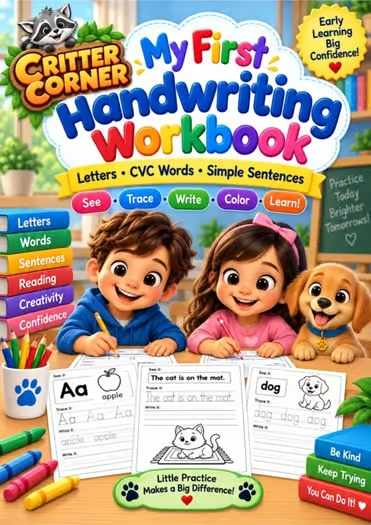
Help young learners build strong handwriting habits, early reading skills, and writing confidence one step at a time with My First Handwriting Workbook!
This 36-page printable handwriting workbook takes children through a simple, child-friendly progression:
Letters → CVC Words → Simple CVC Sentences
Children see, trace, write, and color while developing letter formation, pencil control, word recognition, beginning-sound awareness, early reading skills, and writing confidence.
The workbook begins with uppercase and lowercase A–Z handwriting practice, then moves into CVC word writing and finally introduces simple CVC sentences. This gradual progression helps young learners apply individual letter skills to meaningful words and sentences.
What’s Included
This 36-page printable handwriting workbook includes:
- Colorful workbook cover
- Thank You & Printing Instructions page
- 26 alphabet handwriting pages – A through Z
- Uppercase letter practice
- Lowercase letter practice
- Beginning-sound pictures
- Letter-themed coloring
- Guided letter tracing
- Independent handwriting practice
- CVC word handwriting practice
- Simple CVC sentence handwriting practice
- Picture-supported activities
- Encouraging messages for young writers
- Print-friendly black-and-white student pages
The resource follows a natural progression from individual letters to words and then sentences, making it suitable for beginning writers and early literacy practice.
A–Z Alphabet Handwriting Practice
Children begin by practicing every letter of the alphabet.
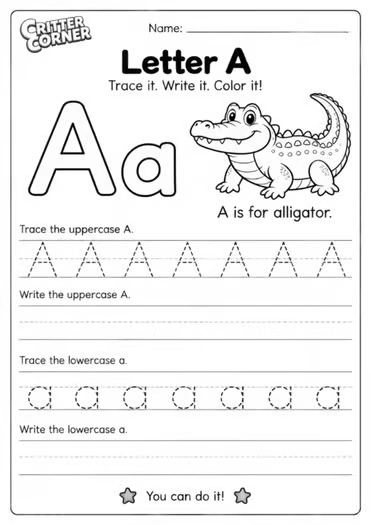
Each A–Z page includes:
- Large uppercase letter
- Large lowercase letter
- Beginning-sound picture
- “[Letter] is for…” vocabulary connection
- Uppercase tracing
- Independent uppercase writing
- Lowercase tracing
- Independent lowercase writing
- Picture to color
- Name line
- Encouraging message
Children repeatedly practice the connection between:
Letter Shape → Letter Name → Beginning Sound → Word → Picture
For example:
A is for alligator.
This turns handwriting practice into an opportunity to reinforce early phonics and vocabulary.
Trace It. Write It. Color It!
The alphabet pages follow a predictable routine:
Trace It → Write It → Color It
Trace It
Children follow dotted letter models to become familiar with the shape and movement required to form each letter.
Write It
After guided tracing, children practice writing the letters independently on handwriting lines.
Color It
Each page includes a beginning-sound illustration to color, adding a fun fine-motor activity while reinforcing the connection between letters and words.
Uppercase & Lowercase Letter Practice
Each alphabet page provides separate practice for uppercase and lowercase letters.
Children first trace each letter form and then practice writing it independently.
This model → trace → write approach helps children move from recognizing letters to forming them without a dotted guide.
Connect Handwriting With Beginning Sounds
The alphabet pages also reinforce early phonics skills.
Children can identify the target letter, say its name and sound, identify the picture, and brainstorm additional words beginning with the same sound.
Try asking:
- What letter did you practice?
- What sound does it make?
- What picture is on the page?
- Can you think of another word beginning with that sound?
A handwriting worksheet can easily become a short letter-sound and vocabulary lesson.
Next Step: CVC Words
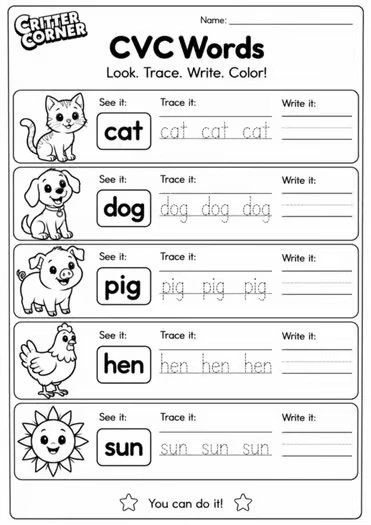
After practicing individual letters, children move into CVC word handwriting practice.
The CVC pages follow a simple routine:
Look → Trace → Write → Color
Children see a picture and its corresponding CVC word, trace the word, write it independently, and color the matching illustration.
Examples include:
- jam
- pot
- lip
- red
- hut
Picture support helps children connect the written word with its meaning while continuing to practice letter formation.
What Are CVC Words?
CVC stands for consonant-vowel-consonant.
Simple CVC words provide an important bridge between learning individual letters and developing early reading and writing skills.
CVC practice helps children work on:
- Letter formation within words
- Left-to-right writing
- Short vowel patterns
- Sound blending
- Sound segmenting
- Word recognition
- Spelling patterns
- Reading simple words
- Writing simple words
- Connecting print with meaning
Children begin discovering that the letters they practice individually can work together to create words.
Letters → Words → Meaning
From Words to Simple Sentences
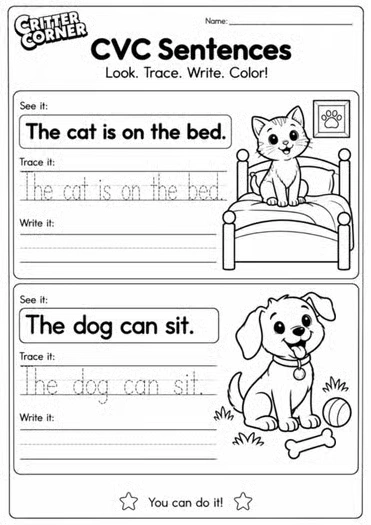
The final stage introduces simple CVC sentences.
Children follow the same familiar routine:
Look → Trace → Write → Color
Examples include:
The sun is hot.
The man has a hat.
Children now apply their handwriting skills to complete thoughts and meaningful sentences.
Sentence practice reinforces:
- Word spacing
- Left-to-right writing
- Capital letters
- Punctuation
- Simple sentence structure
- CVC words in context
- Sight words in simple sentences
- Reading for meaning
- Copying complete sentences
- Independent sentence handwriting
A Step-by-Step Handwriting Progression
The workbook is designed to gradually increase writing complexity.
Step 1: Letters
A → a
Practice individual uppercase and lowercase letter forms.
Step 2: CVC Words
jam
Combine individual letters to create simple words.
Step 3: CVC Sentences
The sun is hot.
Apply handwriting skills to meaningful sentences.
This progression makes the workbook useful for children who are just beginning alphabet handwriting as well as learners ready to move into early word and sentence writing.
Skills Your Child Will Practice
This printable handwriting workbook supports:
- Uppercase letter formation
- Lowercase letter formation
- Alphabet recognition
- Letter identification
- Beginning sounds
- Letter-sound connections
- Pencil control
- Handwriting
- Fine-motor development
- Hand-eye coordination
- CVC word recognition
- CVC word writing
- Short vowel practice
- Early phonics
- Early spelling
- Word formation
- Simple sentence reading
- Simple sentence writing
- Word spacing
- Capitalization awareness
- Punctuation awareness
- Vocabulary development
- Independent work habits
- Writing confidence
More Than Handwriting Practice
Use the workbook to extend learning beyond the printed page.
Beginning Sound Hunt
After completing a letter page, find another classroom object beginning with the same sound.
Say Another Word
Ask children to name another word beginning with the target letter or sound.
Sky Write It
Before writing on paper, have children make the letter in the air using large finger movements.
Build the CVC Word
Use magnetic letters, letter tiles, or alphabet cards to build a CVC word before writing it.
Build it → Read it → Trace it → Write it
Tap the Sounds
Say a CVC word slowly and tap once for each sound.
For example:
j – a – m
Then blend the sounds together:
jam
Read Before You Write
Read each sentence together before tracing it. Talk about the meaning and accompanying picture.
Sentence Detective
Ask children to find:
- The capital letter
- Spaces between words
- The punctuation mark
- CVC words
This helps introduce basic conventions of written language.
Perfect For
This printable handwriting workbook is ideal for:
- Preschool
- Pre-K
- Kindergarten
- Beginning Grade 1 writers
- Homeschool
- Handwriting practice
- Alphabet units
- Letter-of-the-week activities
- Early literacy
- Phonics readiness
- CVC word practice
- Beginning reading
- Beginning writing
- Literacy centers
- Writing centers
- Morning work
- Independent practice
- Early finishers
- Intervention
- School readiness
- Fine-motor practice
- Take-home learning
- Homework practice
- Summer learning
- Extra handwriting support
Print-Friendly for Home & Classroom Use
The student activity pages are designed in black and white, making them practical for everyday printing while giving children the opportunity to color the illustrations.
For best results:
- Print on A4 paper
- Select Actual Size / 100% in your printer settings
- Regular printer paper works well for everyday use
- Cardstock can be used when extra durability is desired
For reusable practice, laminate the pages or place them inside plastic sleeves. Children can then practice with a dry-erase marker, wipe the page clean, and use the resource again.
Flexible Ways to Use the Workbook
Complete Workbook
Work through the resource progressively from letters to words and sentences.
Letter-of-the-Week Practice
Select the alphabet page matching the letter currently being taught.
Literacy or Writing Center
Place selected pages in reusable sleeves for independent handwriting practice.
Intervention
Choose specific letters, words, or skills that a child needs to revisit.
Morning Work
Use one page as a calm, focused start to the school day.
At-Home Learning
Use short practice sessions to reinforce classroom learning without overwhelming young writers.
Cross-Curricular Learning
Handwriting
Practice uppercase letters, lowercase letters, words, and complete sentences.
Phonics
Connect letters with beginning sounds and practice simple CVC patterns.
Reading
Read CVC words and short sentences supported by pictures.
Vocabulary
Build familiarity with letter-themed pictures and simple words.
Fine Motor
Strengthen pencil control through tracing, writing, and coloring.
Art
Color the illustrations and personalize completed pages.
Language
Discuss pictures, brainstorm words, read sentences aloud, and build vocabulary through conversation.
Extend the Learning
Make an Alphabet Book
Keep completed A–Z pages together to create a personal alphabet handwriting book.
Add Another Beginning-Sound Picture
Have children draw another object beginning with the target letter.
Build Before Writing
Before writing a CVC word, let children build it with magnetic letters or letter tiles.
Build it → Read it → Trace it → Write it
Illustrate the Sentence
After completing a sentence, ask children to draw their own picture showing what it means.
Write a New Sentence
For children ready for an extra challenge, choose a CVC word and create another simple sentence using it.
Teacher & Parent Tip
Young children are still developing pencil control, hand strength, and fine-motor coordination.
Short, positive handwriting sessions can make practice more manageable and engaging. Focus on careful effort and gradual improvement, rather than perfect handwriting.
Celebrate small successes:
“You stayed on the line!”
“That letter is easier to read!”
“You remembered where to start!”
“You wrote that word all by yourself!”
Positive encouragement helps young writers develop the confidence to keep practicing.
Why You’ll Love This Resource
- 36-page printable handwriting workbook
- Complete A–Z uppercase practice
- Complete A–Z lowercase practice
- Beginning-sound picture connections
- Guided tracing activities
- Independent handwriting practice
- CVC word handwriting
- Simple CVC sentence handwriting
- Clear progression from letters to words to sentences
- Picture-supported learning
- Coloring activities
- Early phonics practice
- Beginning-sound reinforcement
- Early reading and writing practice
- Fine-motor development
- Pencil-control practice
- Independent learning support
- Print-friendly black-and-white pages
- Reusable with lamination or plastic sleeves
- Suitable for classrooms and homeschool
- Easy to incorporate into literacy instruction
- Supports beginning writers step by step
Little Practice Makes a Big Difference!
Learning to write happens gradually.
First, children learn how a letter looks.
Then they practice how that letter is formed.
Those letters begin joining together to create words.
Eventually, those words become sentences.
My First Handwriting Workbook supports this early writing journey through a simple progression:
See It → Trace It → Write It → Color It → Learn!
From a child’s first uppercase A to writing a complete sentence, every page provides another opportunity to practice, improve, and build confidence.
“I can write this!”
More Critter Corner Learning Fun!
Continue building early literacy skills with other Critter Corner resources, including:
- A–Z Alphabet Puzzles
- Sound It Out! Hands-On Phonics Reading Practice
- Cook-a-Word! Phonics Games
- Build Better Sentences
- Alphabet Activities
- CVC Word Activities
- Phonics Games
- Printable Flashcards
- Literacy Centers
- Early Reading Activities
- Critter Chronicles Storybooks
Pair handwriting practice with letter matching, beginning sounds, word building, phonics games, and early reading activities to create a well-rounded literacy routine.


Reviews
There are no reviews yet.